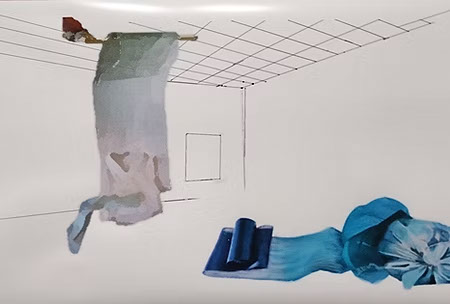
Suspended within a sparse, white room, a slender translucent column hangs from a taut grid of lines, as if caught between construction and disappearance. The surface reads like fragile skin, with shadowed folds and faint marks that feel like memories or imprints. The cloth is anchored at the top by a magnified binyeo—a traditional Korean hairpin—while its lower edge becomes a jeogori, the jacket of a hanbok. As the fabric descends, it transforms from a hanging veil into the body of the garment, shifting the weight from air to ground. The blue textile unfurling on the floor echoes the suspended form’s color yet asserts a heavier presence. The overhead grid suggests measurement and order, but the soft material resists containment, creating a quiet tension between structure and drift. The scene feels like a study of becoming—between installation and collapse, presence and trace.
희고 비어 있는 공간 속에서 가늘고 투명한 기둥 형태가 촘촘한 그리드에 매달려 있어, 구축과 소멸 사이의 과정에 머무는 듯하다. 표면은 연약한 피부처럼 보이며, 그림자진 주름과 희미한 자국들이 기억이나 흔적처럼 드러난다. 상단에서 천을 고정하는 것은 한국의 비녀를 크게 확대한 것이고, 하단은 한복의 저고리로 만들어진다. 비녀에 걸린 천이 바닥으로 내려오면서 저고리로 변하며, 공중의 가벼움이 지면의 무게로 옮겨간다. 바닥에 펼쳐진 푸른 직물은 매달린 형상의 색을 반복하지만 더 묵직한 존재감을 드러낸다. 천장 그리드는 측정과 질서를 암시하지만, 부드러운 재료는 이를 거부하며 구조와 유동 사이의 조용한 긴장을 만든다. 이 장면은 설치와 붕괴, 존재와 흔적 사이에 머무는 ‘되어감’의 연구처럼 느껴진다.