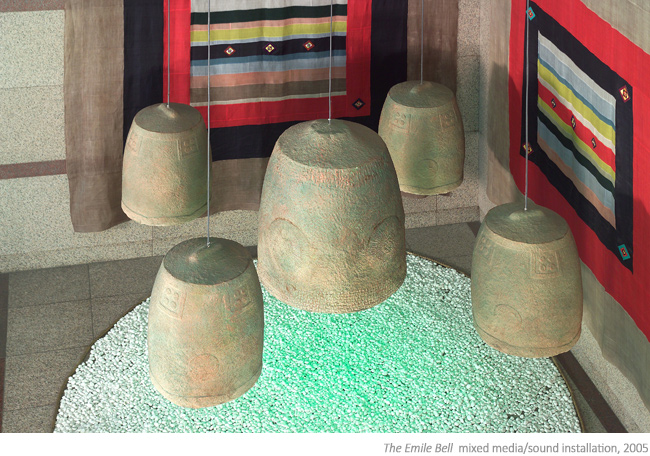
The Emile Bell, 2005
mixed media/sound installation
Echoes of Emile: Resonance of Motherhood and Healing
My artistic journey has always been a transparent reflection of my life-deeply rooted in my mother’s devoted love and my long struggle with illness. Among the many memories that shape my work, one moment remains a spiritual cornerstone: a visit to a Buddhist temple with my mother.
On that day, my mother and I participated in the demanding physical and spiritual ritual of performing three thousand bows. Amid this act of prayer and endurance, the stillness of the temple was pierced by the resonant sound of a bell-the Bell of King Seongdeok, widely known as the Emile Bell.
To an uninitiated listener, it might have been merely a sound. Yet in Korean cultural memory, the word Emile phonetically echoes the cry of an infant calling out to its mother. Hearing that reverberation in the temple’s quietude moved me profoundly. It was not simply the ringing of metal; it was a sonic embodiment of the primal bond between mother and child-a bond that has sustained my life.
Having survived a severe illness, I have long believed that my mother’s unwavering care and encouragement made my survival possible. Her devotion became my “heartbeat,” the force that kept me alive. In that sacred space, the bell’s echo felt inseparable from that heartbeat-transforming sound into a symbol of love, sacrifice, longing, and endurance.
Since that day, I have sought to rediscover and rearticulate that sound and the deep tranquility it carried throughout my artistic practice. This memory gave rise to my installation The Emile Bell (2005). Through this work, I attempt to render visible what is invisible: the meditative moment I shared with my mother, and the universal human “cry” for connection that resonates within us all.
Ultimately, the sound of Emile transcends memory. It becomes a voice of humanity and nature itself-reminiscent of bamboo swaying in the wind-quietly conveying our fundamental need for harmony, healing, and coexistence.
에밀레의 울림: 모성과 치유의 공명
나의 예술 여정은 언제나 삶의 투명한 반영이었다. 그것은 어머니의 헌신적인 사랑과 병을 극복해 온 나의 긴 투쟁에 깊이 뿌리를 두고 있다. 수많은 기억들 가운데, 하나의 순간은 지금까지도 나의 작업을 지탱하는 영적 근간으로 남아 있다. 그것은 어머니와 함께 찾았던 어느 불교 사찰에서의 경험이다.
그날, 어머니와 나는 삼천 배라는 육체적·정신적으로 깊은 수행의 의식을 함께했다. 기도와 인내의 시간 속에서, 사찰의 고요를 가르며 하나의 종소리가 울려 퍼졌다. 신라 성덕대왕신종, 흔히 ‘에밀레종’이라 불리는 그 소리였다.
익숙하지 않은 이에게 그것은 단순한 소리였을지도 모른다. 그러나 한국의 문화적 기억 속에서 ‘에밀레’라는 말은 어머니를 부르는 아이의 울음소리와 닮아 있다. 사찰의 적막 속에서 그 울림을 들었을 때, 나는 깊은 감동을 받았다. 그것은 금속이 울리는 소리가 아니라, 어머니와 아이 사이의 원초적인 유대를 소리로 형상화한 순간이었다. 그 유대는 지금까지 나의 삶을 지탱해 온 생명의 끈이었다.
중병을 겪고 살아남은 나는, 나의 생존이 어머니의 돌봄과 격려 덕분이라고 믿어왔다. 어머니의 헌신은 나의 ‘심장 박동’이 되었고, 나를 살아가게 한 원동력이었다. 그 사찰에서 울린 종소리는 마치 그 박동과 하나가 되어, 사랑과 희생, 그리움과 인내를 상징하는 소리로 다가왔다.
그날 이후 나는 예술 작업 전반에 걸쳐 그 소리와, 그 소리가 품고 있던 깊은 평온을 다시 찾아내고자 했다. 이러한 기억은 설치 작품 *〈에밀레종〉(2005)*으로 이어졌다. 이 작업을 통해 나는 보이지 않는 것을 가시화하고자 했다. 어머니와 함께 나누었던 명상적인 순간, 그리고 우리 모두의 내면에 공명하는 보편적인 ‘연결을 향한 울음’을 형상으로 드러내고자 했다.
결국 ‘에밀레’의 소리는 하나의 기억을 넘어선다. 그것은 인간과 자연의 목소리이며, 바람에 흔들리는 대나무처럼 조용히 울리며, 조화와 치유, 그리고 공존에 대한 본질적인 필요를 전하고 있다.